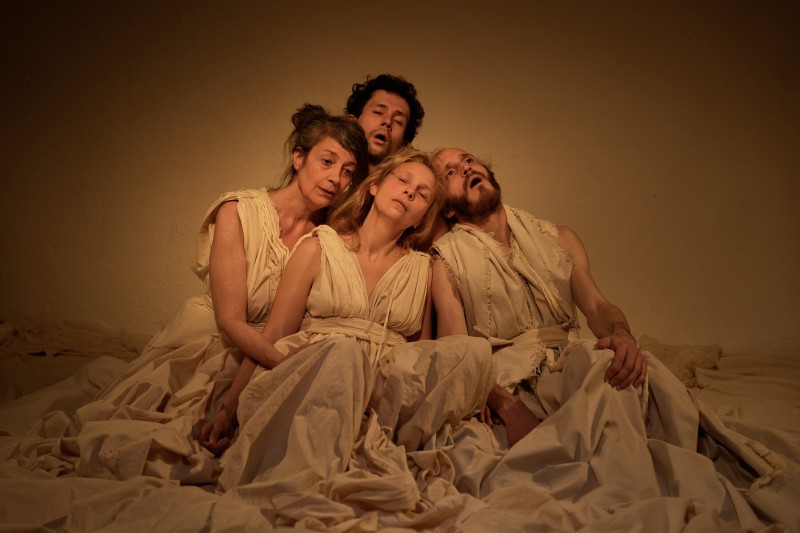
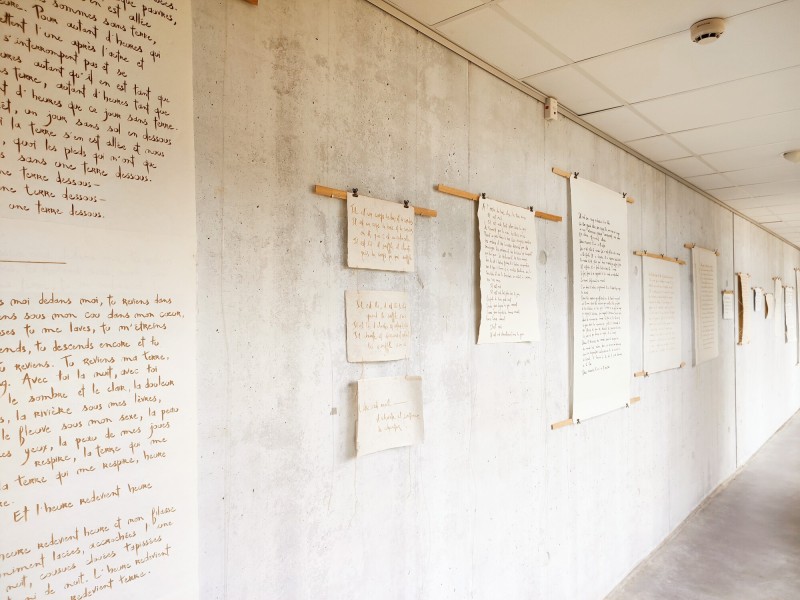
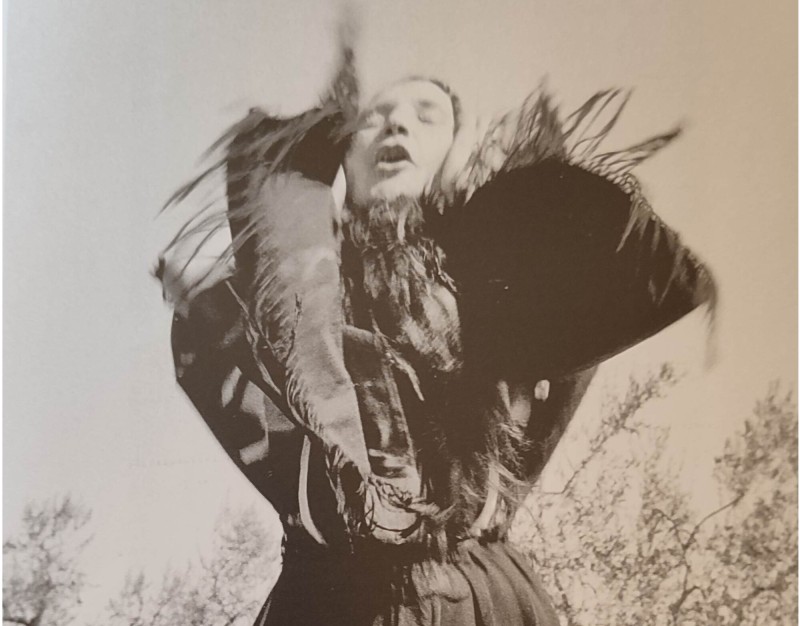
A text by Juliette Kempf written during the first lockdown of 2020 and shared in the company’s newsletter, “Penser la mort,” in November 2025, noting that this reflection remained relevant.
And now, can we talk about death?
Here we are, empty-handed when it comes to certainty. Our gaze is unable to conjure a familiar image, retrieved from memory to paint a picture of what is to come.
Had we forgotten that we knew nothing? Had we forgotten the moment of the great unknown—the one that awaits us all, each and every one of us, whose approaching blows we macabrely count down each evening? Certainly not; how could we forget that we are welcomed here, on this Earth, our sister, only temporarily? How could we forget that the pact—the only one that matters—has been clear from the beginning, from the moment of our arrival: there will be a departure.
The other side of the pact is that we know nothing about this departure. Simply, the intuition that it must be acknowledged, honored, certainly sanctified, at the very least respected. Is it not on this intuition that human consciousness is founded; is it not from this—as research on the earliest burials attests—that a human being becomes a human being? That we become aware of this time, perhaps so brief, yet a gift. And perhaps to savor, in the very heart of Chronos, the vision of the Aeon. Whether one believes, as they say, or does not believe, in either case we do not know; but do we not feel at this point the same call to humility, to that humus to which our physical body itself is called back?
Under normal circumstances, it’s probably no longer all that common to spend several days and nights keeping vigil over someone whose breath has faded away. It’s rare—and a blessing!—to keep vigil at home, a place where the air is filled with the invisible treasures of memories and shared experiences, which is what makes it a home. Grieving seems to have become at odds with our linear, productive concept of time—and with the mindset that underpins it. For grief acknowledges death. Grief suffers, falls, accepts… and smiles again. Yes, why not smile in the face of what we do not know? Why not smile at this time that has already passed; at those thousands of steps taken upon the Earth’s surface?
What immense void within our very being makes its end so terrifying? What gaping void within us causes such anguish in the face of our destiny? If we are willing to look at the flower as it blooms, the leaf as it withers, the tree when it stands bare, does this destiny not ultimately seem simple to us? What choice of consciousness do we make when we decide to cast a fearful gaze upon the human cycle? Am I not the master of the gaze I cast upon the mystery of life? Has even my own gaze been brought under control? I do not believe so. I believe that we remain free—even when confined, monitored, and fined—in the way we view things and life itself.
Today, of course, the situation is exceptional. Where the epidemic is severe, the death toll is higher than usual. But can we take a look at the absurdities we’ve been thrust into? The goal is to reduce the number of deaths. It’s about ensuring that, when comparing our nation’s statistics to those of other nations, we don’t reach an explosive number. In the name of preventing death, how do we treat it? How do we support the dying, and how do we support the bereaved after their loved ones have passed? How do we experience the time of funerals, a fundamental rite for both the deceased and the living? Our modern society has decided to monitor the numbers and that there should be few deaths, but the conditions under which these deaths occur seem to matter little to it. Perhaps we can reflect on the fact that in certain traditional cultures, such as Judaism, it is forbidden to “count human beings.” For a human being is not quantifiable; they are qualitative, subjective, and worthy of respect.
There is no doubt that many people caring for the sick have acted and continue to act to the best of their ability under current conditions, and suffer from the shortcomings of material support, which are, of course, unacceptable. But beyond that, let us dare to examine our societal inability to provide intimate, subtle, and unique support during the final journey. Let us examine our refusal to accept death as a value of life.
This is laid bare before us in the harshness of the crisis; but it did not begin with this crisis, which merely reveals to us, in a blinding and painful light, where we stand. Ever since we thought we knew?
Isn’t it time to remember that human beings are destined to die, and to reintegrate this into our vision of life’s journey, without it becoming an “unfortunate side note”? Is it possible to say that the elderly are destined to die? Doesn’t the obsession with “individual isolation” that has taken hold seem like a futile denial, an attempt to hide from the inevitable encounter? Isn’t it, rather, healthier to prepare for it and welcome it, with full awareness? Isn’t it healthier to talk about death with those who are nearing it—which is only natural—and to soothe any anxieties that may be associated with it, through conversation and presence, rather than leaving them in the abyss of absence, in silence…? Is a death experienced with full awareness necessarily one death too many? This is laid bare before us in the harshness of the crisis; but it did not begin with this crisis, which merely reveals to us, in a blinding and painful light, where we stand. Since when did we think we knew?
To us, who are shaping the world of tomorrow, it seems to me that this reverence in the face of death, in the face of the unknown—which we so cruelly lack—simply reveals the way we inhabit the world, our host. Perhaps, in fact, it is this forgetfulness that gives rise, among other forms of forgetfulness, to the way we inhabit the world. We need only look at how we inhabit it and reflect. Do we not see connections with the way we approach death—the one that is supposed to come only “later,” “without me,” the one we’ll think about “afterward,” the one that is merely a “material thing,” “quantifiable”…? Do we not see the connections?
Are we not slaves to the myth of the infinite? Is it not easier to pretend that the resources of our environment are unlimited, when we strive to believe that life itself is unlimited—while scrupulously hiding its end?
How would we inhabit the world if we regained an awareness of the cycle of life, including death? If we were once again capable of honoring it, rather than seeking to avoid it at all costs? If we could see, in the face of death, the affirmation of our smallness—and with it, in fact, the immensity of the earthly experience? Would we be able to relearn how to love rather than consume?
Death reminds us that we do not know, that we see nothing. The voracity of this unknown virus brings tears to our eyes. The tears pass, and the energy of love that gives rise to them is also a tremendous energy of life and consciousness—if we grasp the lesson taught to us by the natural cycle of decomposition and recreation. Will we open our eyes once more to what living things do not tell us, to what they conceal that is invisible? And realizing that the space in which we live is not merely quantifiable matter would undoubtedly lead us to experience it differently.
Without waiting for our mediocre politicians to deign to assign real—rather than numerical—value to the human condition, let us dare to change our own perspective.
(...)
[Et déjà, une bribe de souvenir semble revenir. La vie, pour être vie, ne demande-t-elle pas à certains de ses membres de se défaire, de se déliter, de se dissoudre, afin que le processus de renouveau perdure, et que ce qui disparaît devienne nourriture ? Les senteurs ne se succèdent-elles pas les unes aux autres, attestant de l’harmonieuse vitalité des saisons ?]
March 2020